Last week, a gold company most Americans would recognize went bankrupt.
If you’ve watched cable news in the last decade, you’ve seen Rosland Capital’s commercials: actor William Devane, a gold coin, and a warning about the dollar. On July 2, 2026, Rosland filed for Chapter 11 bankruptcy in the U.S. Bankruptcy Court for the Central District of California. The filing lists $50 million to $100 million in liabilities against just $1 million to $10 million in assets. Here’s the part that should stop you: more than $60 million owed to hundreds of customers who prepaid for metal they never received (TheStreet).
Sit with that for a second. Gold hit record highs on its way to more than $5,000 an ounce over the past year. And in the middle of the biggest gold bull market of our lifetimes, a gold dealer collapsed. That only happens when the business was never really about the metal.
There’s no satisfaction in writing this. Real people lost real money, many of them retirees who believed they were finally doing the safe, responsible thing with their savings. I’m sharing it because I’ve watched this same story repeat since 2008, and I would far rather you understand why it keeps happening than watch it happen to you or someone you love. If this helps one family hold on to what they worked a lifetime for, it was worth writing.
The tell is in the filing
Here’s what the Rosland bankruptcy actually shows. The company paid its sales representatives commissions of 15% to 35% of gross profit (TheStreet). It owed Fox News alone more than $1.9 million in advertising bills. And it had taken in roughly $49 million in “deferred revenue,” meaning customer money for orders it hadn’t yet filled, while carrying an $11.8 million buy-back list.
Read that again. The company had customers’ cash, but not their gold. When metal prices spiked and its cost to actually buy the gold ran past what customers had already paid, the model broke. The people who “bought” gold discovered they hadn’t bought gold at all. They’d bought a promise, and that promise put them in line behind everyone else the company owed.
That’s not an accident of one badly run firm. It’s the predictable end state of a specific way of doing business.
This isn’t one bad apple. It’s the model.
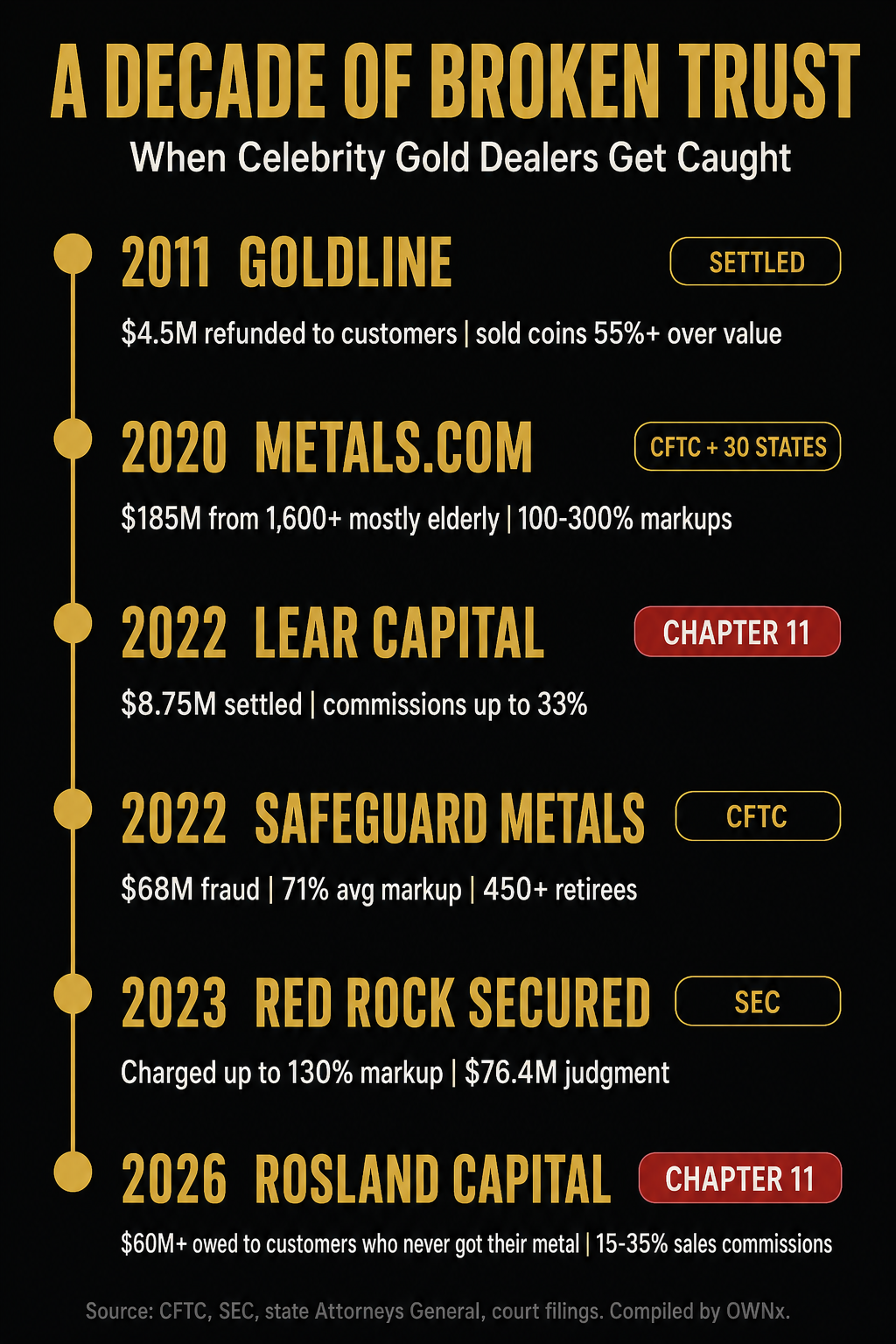
Rosland is the latest, not the first. Look at the last few years of enforcement actions and you’ll see the same shape every time:
- Lear Capital, another dealer famous for its TV and talk-radio ads, filed for bankruptcy in March 2022. The New York Attorney General had sued it for charging undisclosed commissions of up to 33% on more than $43 million of sales to roughly 1,000 New Yorkers, and Lear settled for $6 million (NY AG). The Los Angeles City Attorney settled a parallel case for $2.75 million (LA City Attorney).
- Metals.com: the Commodity Futures Trading Commission and 30 states charged it in 2020 with a scheme that took in more than $185 million from at least 1,600 mostly elderly customers, selling coins at markups of 100% to more than 300% over their real value (CFTC).
- Red Rock Secured: the SEC charged the firm and its CEO in 2023 for telling investors they’d pay markups of 1% to 5% while actually charging as much as 130%, and entered a $76.4 million judgment (SEC).
- Safeguard Metals: the CFTC and dozens of states charged it in a $68 million fraud that hit more than 450 retirees with an average markup of 71%, against a maximum it had claimed was 23% (CFTC).
Different names, same recipe. As The Washington Post documented in its investigation of the industry, the pattern is almost a script: fear-based advertising warns you the dollar is about to collapse, a commissioned salesperson convinces you to move your retirement savings, and you end up in overpriced “proof” or “collectible” coins that quietly cost far more than the metal inside them (Washington Post).
Follow the money
Once you understand where the markup goes, the whole thing snaps into focus.
Standard bullion, like a one-ounce American Eagle, a Krugerrand, or a plain bar, typically sells for about 4% to 8% over the value of the metal. The “collectible,” “proof,” and “semi-numismatic” coins these advertised dealers push instead can run 20%, 50%, 100% or more over the metal’s value (CFTC). That gap is not value you’re getting. It’s the celebrity, the ad buy, and the commission, paid by you on the way in.
And it’s paid again on the way out, because that premium almost never comes back when you sell. The CFTC has documented cases where a single $300,000 retirement rollover carried roughly $150,000 in fees and commissions (CFTC). Half. Gone. Before the metal did anything.
The people who buy metal for a living understand this better than anyone. Spend ten minutes in the precious-metals communities on Reddit and you’ll read some version of this, over and over. As one investor put it bluntly on r/Gold: “Most gold IRAs are scams. They sell you high premium metals and add crazy fees. You’re paying for them to be able to pay their salesforce” (r/Gold). The advice they give newcomers is remarkably consistent: buy plain bullion close to the metal’s value, never “rare” coins, and be suspicious of anything sold to you on television.
The question nobody in those ads answers: where is your metal?
There’s an old rule in precious metals: if you don’t hold it, you don’t own it. Rosland’s customers believed it. They were buying real coins and bars to take delivery, not paper, and they still lost their money, because the danger was never paper versus physical. It was the gap between paying and holding, and that’s the part no dealer puts in the ad.
When you send money to a dealer that holds little inventory and uses your payment as operating cash, you don’t own gold. You own an IOU. If the company fails, as Rosland did, as Lear did, and as Regal Assets did when its CEO allegedly misappropriated $21 million and left the country (CFTC), you’re not a gold owner. You’re an unsecured creditor, and you find that out at the worst possible moment.
Ownership should mean ownership. The metal should be allocated in your name, held in an insured, independent depository, and kept off the dealer’s balance sheet. Then if the company disappears tomorrow, your gold was never theirs to owe to anyone. It’s yours.
That’s the model my co-founder, Jeremy Brakenhoff, and I set out to build in 2008, in the middle of that same financial crisis. We started from a simple, stubborn conviction: a person setting aside fifty dollars a month deserves the same honest price as an institution buying a whole bar. That idea became SilverSaver in 2009, and OWNx today. We’ve built it the boring way on purpose, with no commissioned sales floor, no celebrity spokesperson, and zero debt, because the people who trust us with their savings should never have to wonder whose interests come first. I would rather build a company that quietly earns trust year after year than one that grabs attention for a moment.
I’ll be straight with you, because a piece about honesty has no business pretending otherwise: OWNx is not always the cheapest place on the internet to buy a single coin, and our members can see exactly what they pay before they buy. Some buyers who want the rock-bottom price on one purchase will do better elsewhere, and I’ll tell them so. What we refuse to do is hide the number, pay someone a commission to talk you out of your retirement account, or sell you a “rare” coin you’ll lose half your money on. Transparent pricing, metal you actually own, and the freedom to sell whenever you want: that’s the whole promise.
What to take from all of this
You don’t need to trust me. You need to ask any dealer four questions and insist on written answers:
- What is my exact, all-in price?
- Is my metal allocated in my name, in an insured third-party depository, or am I holding a promise?
- What will you pay me when I sell, today?
- How are the people selling to me paid?
An honest dealer answers all four without flinching. To check the answers you get, see how gold IRA companies compare on fees and spreads. If a company spends more on a celebrity than it’s willing to spend on disclosure, you already have your answer.
Gold and silver are supposed to be the part of your savings that can’t vanish. You worked hard for that money, so make sure the way you own it lives up to the promise.
Continue the series: Part 2 on whether the gold you paid for is really yours, and Part 3 on the five red flags that give a bad dealer away.
Frequently asked questions
Did Rosland Capital go bankrupt?
Yes. Rosland Capital filed for Chapter 11 bankruptcy on July 2, 2026 in the U.S. Bankruptcy Court for the Central District of California, listing $50 to $100 million in liabilities and more than $60 million owed to customers who had prepaid for metal they never received (source).
How much markup do gold dealers charge?
Standard bullion typically sells at about 4% to 8% over the value of the metal. “Collectible,” “proof,” and “semi-numismatic” coins pushed by heavily advertised dealers can carry markups of 20% to more than 300%, and that premium is generally not recoverable when you sell (CFTC).
What happens to my gold if a dealer goes bankrupt?
If your metal was allocated in your name and held in an independent, insured depository, it remains yours. If you merely prepaid a dealer that holds little inventory, you may be treated as an unsecured creditor and stand in line behind the company’s other debts, which is what happened to Rosland’s customers.
Can I get my money back from a bankrupt gold dealer?
Often only in part. Customers who prepaid Rosland Capital for undelivered metal are unsecured creditors in the Chapter 11 case, meaning they stand behind secured lenders and typically recover only a fraction of what they are owed. Metal that is allocated in your name at an independent depository is not part of the dealer’s bankruptcy estate.
How can I avoid gold-dealer scams?
Ask for your exact all-in price over the metal’s value in writing, confirm your metal is allocated in your name at a third-party depository, ask what the dealer will pay you if you sell today, and ask how its salespeople are compensated. Be cautious with dealers that lead with fear-based advertising or celebrity endorsements.