In Part 1 I wrote about why celebrity-endorsed gold dealers keep going bankrupt. This piece is about the part of that story that matters most: when one of them fails, is your gold actually yours? A bad price costs you some money. The wrong kind of ownership can cost you the whole thing.
There’s an old rule in precious metals: if you don’t hold it, you don’t own it. It’s good advice, and it’s why a lot of people buy physical metal in the first place. But the Rosland story shows the rule has a blind spot. Rosland’s customers weren’t buying paper or a share of a fund. They were buying real coins and bars to take delivery and hold themselves, doing exactly what the rule says to do. They still lost their money, because the danger was never paper versus physical. It was the gap between paying and holding.
So here’s the sharper question to carry into any conversation with a dealer: if this company disappeared tomorrow, would my gold still be mine? For a lot of people who thought they owned precious metals, the honest answer turned out to be no.
The IOU model
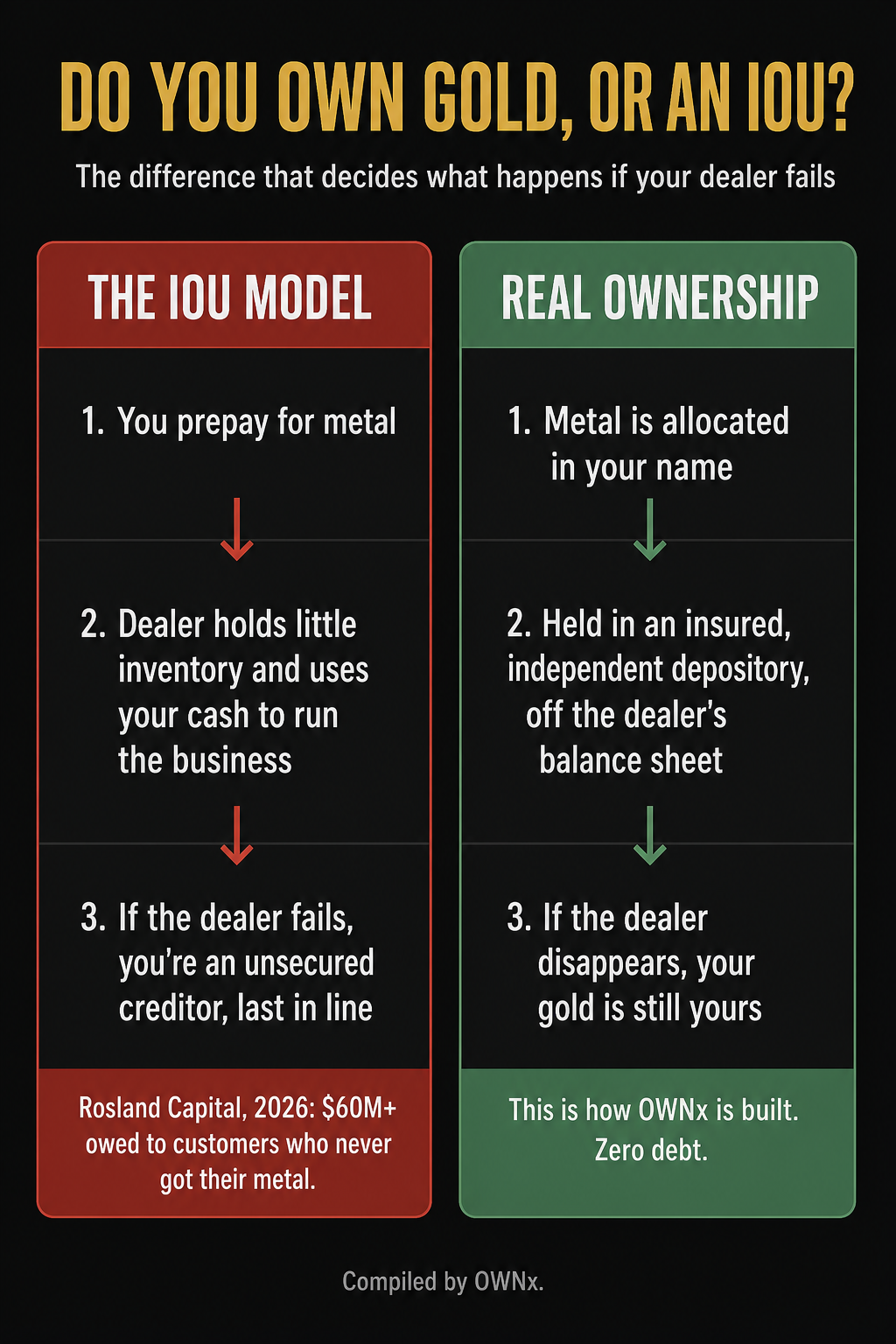
Picture how many advertised dealers actually work. You send money for gold. The dealer holds little or no inventory of its own. Your cash goes into the business, to pay for ads, salaries, commissions, and the metal owed to the last batch of customers. As long as new money keeps coming in and prices stay calm, the wheel turns and orders get filled.
You feel like a gold owner. On paper, you’re something else. You’re a customer holding a promise, and that promise lives entirely in the gap between the day you pay and the day the metal is actually in your hands. It’s only as good as the company’s cash flow.
When the wheel stops, everyone finds out at once. That’s what happened at Rosland Capital, which filed for Chapter 11 owing more than $60 million to customers who prepaid for metal they never received (TheStreet). Those customers weren’t treated as gold owners in the bankruptcy. They became unsecured creditors, near the back of the line, hoping to recover cents on the dollar.
And sometimes the metal was never there at all. When the CFTC went after Regal Assets, it alleged the firm’s CEO misappropriated more than $21 million from customers and left the country (CFTC). People who believed they owned gold owned nothing.
Allocated versus unallocated
There’s a piece of plumbing that decides which side of this line you’re on, and dealers rarely explain it.
Unallocated metal means you have a claim against the dealer’s general pool, or simply against the dealer itself. You’re owed gold, but no specific gold is set aside as yours. If the company fails, your claim joins everyone else’s.
Allocated metal means specific, identified metal is set aside and titled to you. It isn’t the dealer’s asset. It doesn’t sit on the dealer’s books. If the company fails, that metal was never theirs to lose, so it isn’t part of the bankruptcy.
The word to listen for is “allocated.” If a dealer can’t tell you plainly that your metal is allocated in your name, assume it isn’t.
What real ownership looks like
Good custody is boring, and boring is exactly what you want here. It looks like this:
- Your metal is allocated in your name, not pooled and not merely promised.
- It’s stored in an insured, independent third-party depository, not in the dealer’s back office and not on the dealer’s balance sheet.
- The depository is named, and the arrangement is audited, so someone independent confirms the metal is actually there.
Ask for all three in writing. Ask which depository holds the metal. Ask whether it’s insured and audited. A dealer doing this right will answer immediately, because these are the facts they’re proud of.
How we built OWNx
This is the part of the business I care about most, because it’s the part that protects people when things go wrong.
At OWNx, your metal is allocated in your name and held in insured, independent depositories, off our balance sheet. If OWNx disappeared tomorrow, your gold and silver were never ours to owe to anyone. They’re yours. We also carry zero debt, so there’s no leverage waiting to unwind and no reason to lean on customer prepayments to keep the lights on.
I said in Part 1 that we built the company the boring way on purpose. This is what I meant. The goal was never to be the flashiest name in precious metals. It was to build something where the honest answer to “is my gold still mine?” is always yes.
Next in the series: how this industry targets retirees, and how to protect the people you love. Start from Part 1.
Frequently asked questions
What happens to my gold if a precious metals dealer goes bankrupt?
If your metal was allocated in your name in an independent, insured depository, it stays yours and isn’t part of the bankruptcy. If you only prepaid a dealer that holds little inventory, you may be treated as an unsecured creditor and recover only a fraction of what you’re owed, which is what happened to Rosland Capital’s customers.
What’s the difference between allocated and unallocated gold?
Allocated means specific metal is set aside and titled to you, off the dealer’s books. Unallocated means you hold a claim against the dealer’s pool or the dealer itself. Allocated ownership survives a bankruptcy. Unallocated usually does not.
How do I know my gold is really being held for me?
Ask that your metal be allocated in your name, ask which insured third-party depository holds it, and ask whether the holdings are audited. Get the answers in writing.