In Part 1 I wrote about why celebrity-endorsed dealers keep collapsing, and in Part 2 about whether you actually own the gold you paid for. Underneath all of it is a pattern I find harder to write about calmly, because of who it targets.
Look at who the regulators say got hurt. Metals.com took in more than $140 million of retirement savings from at least 1,600 mostly elderly customers (CFTC). Safeguard Metals hit more than 450 retirees (CFTC). Red Rock Secured convinced people to move retirement accounts, TSPs, and 401(k)s into overpriced coins (SEC). The New York Attorney General found Lear Capital had sold to roughly 1,000 New Yorkers, many of them elderly (NY AG).
This is not a coincidence. It’s the business model.
Why retirees
The math from the dealer’s side is cold but simple. Retirees have often spent a lifetime saving, so the accounts are large. They tend to trust a confident voice on the phone. And they carry a real, reasonable fear of losing what they’ve built. A sales script that mixes those three things, a big balance, trust, and fear, is a script designed to move a lot of money quickly.
The Washington Post traced how the industry runs on exactly this: fear-based advertising, often on partisan media, that warns the dollar is about to collapse, followed by a commissioned rep who moves the person’s retirement savings into high-markup coins (Washington Post). The fear is manufactured. The urgency is manufactured. The losses are real.
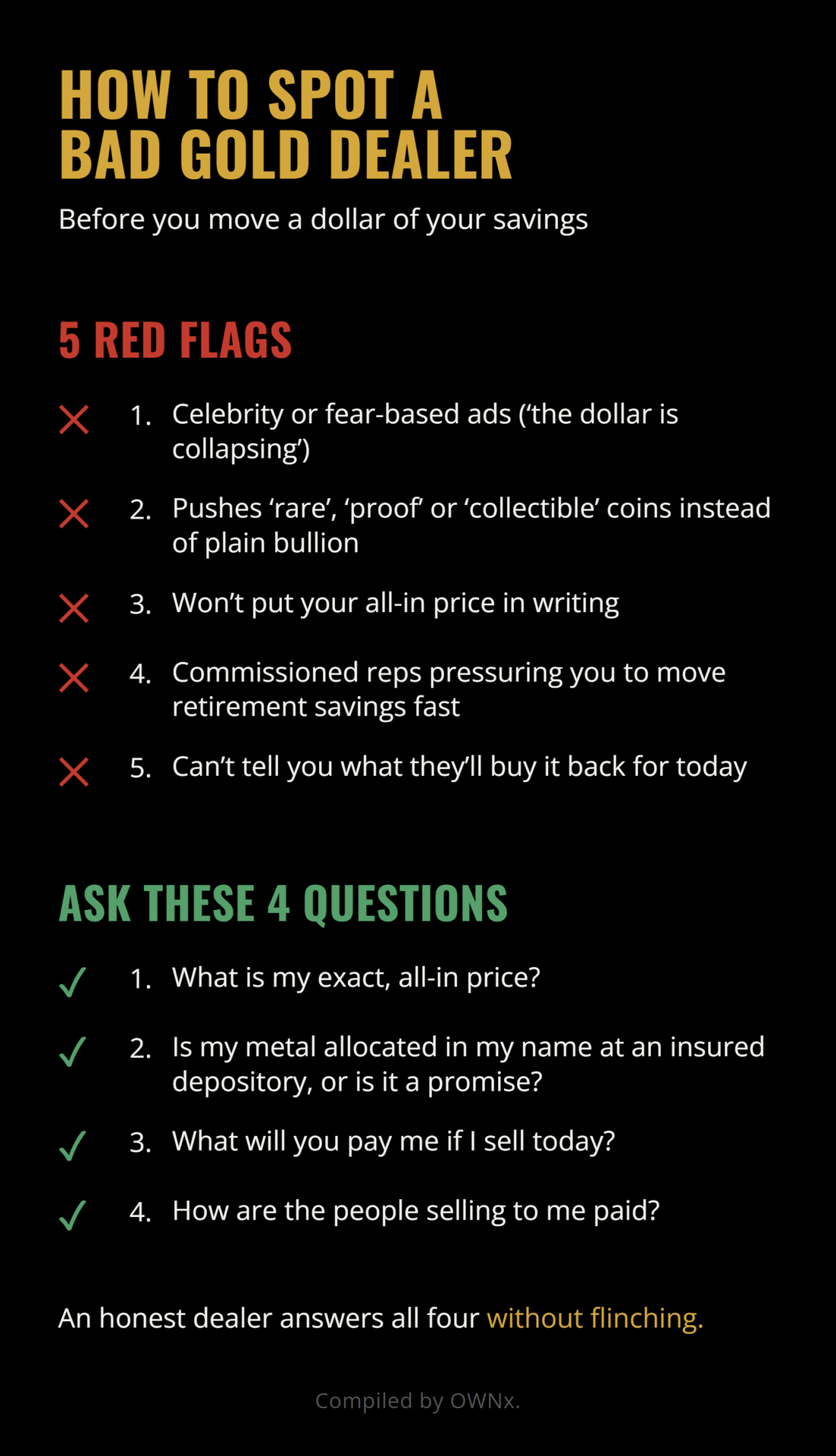
Five red flags
If you see these, slow down. Any one of them is a reason to pause. Together, they’re a reason to walk away.
- Celebrity or fear-based ads. “The dollar is collapsing, act now.” Urgency is a sales tactic, not financial advice.
- Pushing “rare,” “proof,” or “collectible” coins instead of plain bullion. That’s where the biggest hidden markups live, often two or three times what the metal is actually worth.
- Won’t put your all-in price over the metal’s value in writing. An honest price survives being written down.
- Commissioned reps pressuring you to move retirement savings fast. Good decisions about your life savings are rarely made on a timer.
- Can’t tell you what they’ll buy it back for today. If the resale number is embarrassing, they’ll avoid it.
Four questions that protect anyone
You don’t need expertise to be safe. You need to ask these and insist on written answers:
- What is my exact, all-in price over the metal’s value?
- Is my metal allocated in my name at an insured depository, or is it a promise?
- What will you pay me if I sell today?
- How are the people selling to me paid?
An honest dealer answers all four without flinching. A dealer who dodges even one has told you what you need to know.
If it’s your parents
This is the practical part. If someone you love is talking to a gold dealer, especially one they heard on the radio or television, you don’t need to lecture them. Offer to help.
- Sit in on the call, or ask to review anything before they sign.
- Ask the four questions above, together, and write the answers down.
- Compare the quoted all-in price to what the metal is actually worth before any money moves.
- If the rep pushes “collectible” coins into an IRA, stop. The IRS generally prohibits collectible coins in retirement accounts, and that alone signals a bad actor. For a fair baseline, see gold IRA companies compared on fees.
None of this is about fear. It’s about slowing a fast pitch down long enough for good judgment to catch up.
What we try to be instead
I started OWNx in 2008 because I was tired of watching this happen to people who deserved better. So we built the opposite of the phone room. There’s no commissioned sales floor calling your parents, no celebrity spokesperson, and no fear script. The price is on the screen, you can start with as little as twenty five dollars, and the metal is allocated in your name.
We’d rather earn a little trust from a lot of people, slowly, than take a lot of money from a few, fast. That’s the whole company, and it’s the whole point of this series.
Start from Part 1, or read Part 2 on whether the gold you paid for is really yours. If this could help someone in your family, please pass it along.
Frequently asked questions
Why do gold dealers target retirees?
Retirement accounts hold large balances built over a lifetime, older savers often extend trust to a confident salesperson, and a fear-based pitch about the economy can drive fast decisions. Regulators have documented this pattern in cases against Metals.com, Safeguard Metals, Red Rock Secured, and Lear Capital.
How can I protect my parents from a gold IRA scam?
Offer to sit in on the call or review anything before they sign, ask the dealer for the all-in price over the metal’s value, confirm the metal is allocated in their name at an insured depository, ask what the dealer will buy it back for today, and ask how the salespeople are paid. Be especially cautious with dealers advertising on TV or radio.
Is it a bad sign if a dealer wants to put collectible coins in an IRA?
Yes. The IRS generally prohibits collectible coins in IRAs. A rep who insists a ‘rare’ or ‘proof’ coin belongs in a retirement account is showing you a red flag.