Real gold is non-magnetic and very dense, and pure gold does not react to acid. The seven tests below check those properties on any gold piece, from gold jewelry to a bullion coin or bar, and you can run all of them in under an hour with household items plus a cheap gold testing kit.
The 7 home tests, in the order to run them
No single home test is conclusive. Each one rules out some fakes and misses others, and no DIY test can tell you genuine gold from a well-made fake with certainty. The cheapest way to test gold at home is to run them as a sequence, least destructive first, and keep notes as you go. A piece that passes all seven has shown no problem at home, which is as far as home tests go. Bars and valuable coins still need a professional test that reads through the metal. A piece that fails any one is probably fake gold, or lower karat than marked, so stop and get it checked.
1. Hallmark: read the purity stamp
What you need: a jeweler's loupe or a strong magnifying glass.
- Look inside ring bands, on clasps and near chain ends. Bars and coins carry it on the face.
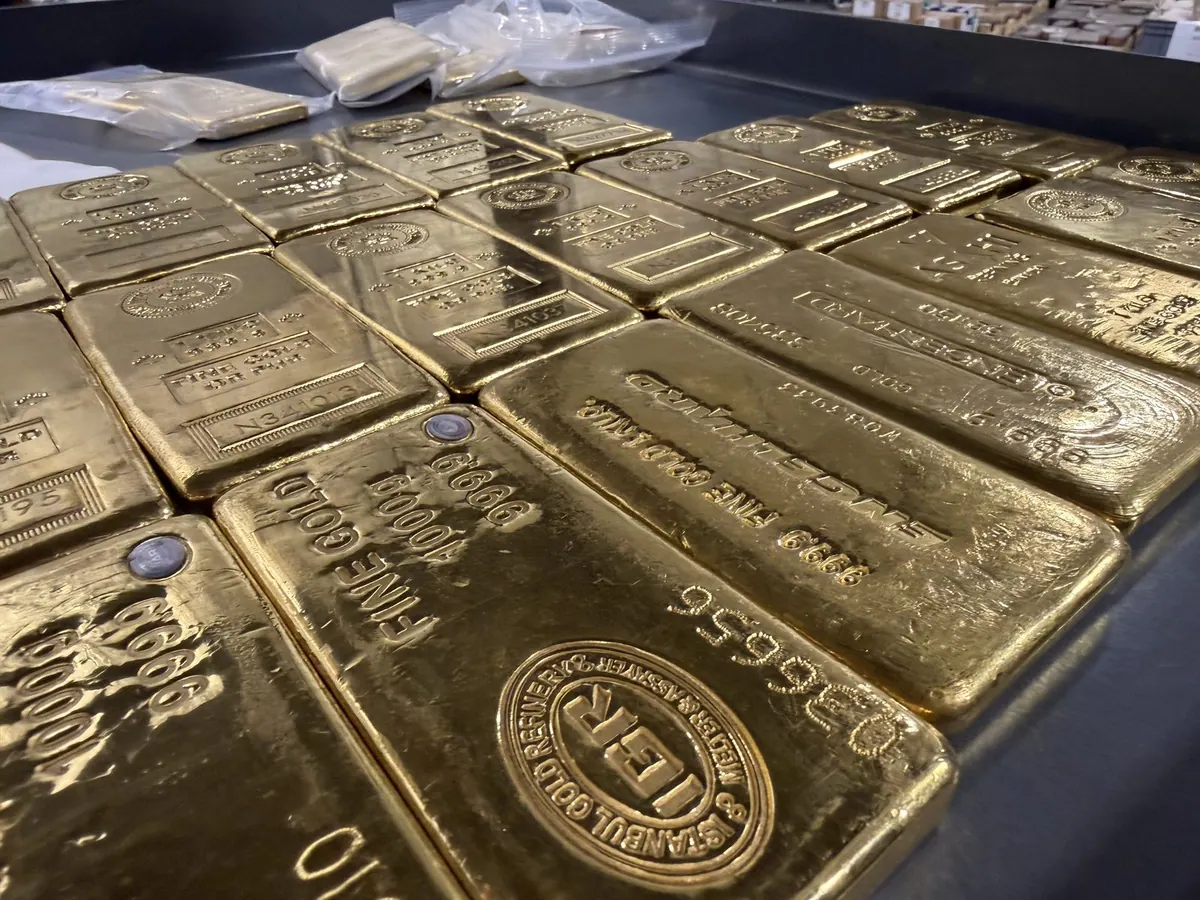
- Read the karat or fineness mark: 375 = 9K, 417 = 10K, 585 = 14K, 750 = 18K, 916 = 22K, 999 or 9999 = 24K.
- Check for plating codes: "GP", "GF", "HGE", "RGP" or "1/20 12K". Each means plated or filled.
Our guide to gold purity, karats and fineness explains the scale. In the US, the FTC Jewelry Guides let a seller call an item gold at any karat as long as the karat is disclosed, so a 9K mark is legal and a missing karat is the warning sign. A stamp is easy to fake, so treat it as a first screen only.
| Pass | A clear karat or fineness mark with no plating code. |
|---|---|
| Fail | A plating code, or a mark you cannot find or read. Either way, keep testing. |
2. Magnet test
What you need: a strong magnet, ideally neodymium. A fridge magnet is too weak.
- Set the piece on a table.
- Bring the magnet slowly toward it from the side.
- Watch for any pull, slide or lift toward the magnet.
- Test the clasp separately. Clasps often hide a steel spring.
Pure gold is diamagnetic, so a magnet will never pull it. A pull means iron, nickel or steel is in the piece. That is common in plated items. Nickel white gold is the exception: it can show a faint pull and still be real gold jewelry, so a weak response on white gold is inconclusive. No pull does not prove gold either, because brass, copper, tungsten and lead are non-magnetic too. Our guide to gold and magnets covers the physics.
| Pass | No pull at all on the body of the piece. |
|---|---|
| Fail | A clear pull on the body of a yellow-gold piece, not just the clasp. A faint pull on white gold is inconclusive, so move on to the acid test. |
3. Float test
What you need: a glass or bowl of water deep enough to cover the piece.
- Fill the container with water.
- Drop the piece in from just above the surface.
- Watch how fast it falls.
- Dry it well afterward.
Gold is about 19.3 g/cm³, far denser than water, so real gold sinks. A piece that floats is not solid gold. Sinking proves little on its own, because brass, tungsten, lead and most other fake gold sink too, so this test only rules out the lightest fakes. Hollow pieces, like some hoops and lockets, trap air and can hang in the water even when the metal is real.
| Pass | Sinks. Keep testing, since most fakes sink too. |
|---|---|
| Fail | Floats, or hangs near the surface on a solid piece. |
4. Ceramic streak test (scratch test)
What you need: an unglazed ceramic tile, or the unglazed ring on the underside of a plate or mug.
- Pick a spot on the piece that won't show, such as the inside of a band.
- Drag it lightly across the unglazed ceramic in one short line.
- Check the color of the streak in good light.
- Wipe the ceramic clean.
Gold leaves a gold or yellow streak. Pyrite and most plated base metals leave a black or greenish-black streak. Unglazed ceramic is abrasive and can scratch the piece, so press lightly and skip this test on polished heirlooms. Thick plating can still leave a gold streak, so a pass here is not proof.
| Pass | A gold or yellow streak. |
|---|---|
| Fail | A black, gray or greenish-black streak. |
5. Vinegar test
What you need: white vinegar and a dropper or cotton swab.
- Put a few drops of white vinegar on an inconspicuous spot.
- Leave it for about 15 minutes.
- Look for any change in color or any bubbling.
- Wipe off the vinegar, rinse with water and dry.
Gold does not react to vinegar. Some base metals darken, discolor or fizz, but many show nothing in 15 minutes, so no change is inconclusive. This is a mild acid screen, not a purity test. It can expose a plated piece where the plating has worn thin, but it cannot tell 10K from 18K.
| Pass | No change. Inconclusive, so keep testing. |
|---|---|
| Fail | Darkening, discoloration or fizzing. |
6. Acid test on a touchstone
What you need: an acid testing kit with a testing stone and solutions marked 10K, 14K, 18K and 22K (nitric acid, with mixed acids for the higher karats), plus gloves and eye protection.
- Put on gloves and eye protection. Work in a ventilated space.
- Rub the piece firmly on the testing stone to leave a solid streak. If you suspect plating, file a tiny notch in a hidden spot first and rub the notch, or the acid only ever sees the gold layer.
- Drop on the solution marked for the karat you suspect, following the kit's instructions.
- Watch the streak for 20 to 30 seconds.
This is the test a professional jeweler or pawn shop runs at the counter, usually against reference needles of known karat. If the streak dissolves, the piece is lower karat than the bottle or not gold. On exposed base metal the acid turns green. On gold-plated silver it turns milky. Acid will mark the item, so keep it on the stone.
| Pass | The streak holds under the acid for the stamped karat. |
|---|---|
| Fail | The streak dissolves, turns green, or turns milky. |
7. Density test (specific gravity test)
What you need: a scale that reads 0.01 g, a graduated cylinder in mL, water and thread.
- Weigh the dry piece in grams.
- Fill the cylinder partway and note the water level.
- Hang the piece on the thread, fully under water and touching nothing. Subtract the two levels to get volume (1 mL = 1 cm³).
- Divide weight by volume.
Our guide to the density of gold explains why gold alloys vary. The method needs a solid, stone-free piece of a few grams or more. Hollow or gem-set items read low, and thin chains have too little volume to measure.
| Karat | Density (g/cm³) |
|---|---|
| 24K | About 19.3 |
| 22K | About 17.7 to 17.8 |
| 18K | About 15 to 16, by alloy |
| 14K | About 12.9 to 14.6 |
| 10K | About 11.1 to 11.6 |
Tungsten is 19.25 g/cm³, so density cannot catch a tungsten-cored bar. That is why bars get checked by XRF or ultrasound.
| Pass | Within the range for the stamped karat. |
|---|---|
| Fail | Outside that range, high or low: plated, filled, or not gold. |
Skin test and other quick checks that are only hints
These checks are popular, but none of them should decide anything on its own.
- Skin test: wear the gold jewelry for a day. Green or black marks on your skin usually point to base metal. But clean gold can also leave marks on some people, especially with lotions, makeup or sweat.
- Bite test: a myth. Biting proves nothing, since lead is softer than gold, and teeth marks damage a real coin or ring.
- Ring test: balance a coin on your fingertip and tap it gently with another coin. Compare the sound to a known-good coin of the same type, since the note depends on the metal, the size and the design. A coin that sounds clearly different from its twin needs a closer look. On its own the result is inconclusive.
Common fakes and what each test catches
| Fake | Magnet | Float | Streak | Acid | Density | Catches it |
|---|---|---|---|---|---|---|
| Gold-plated brass or copper | No pull | Sinks | Gold until worn | Passes on plating | Too low | Density, acid at a notch |
| Gold-plated steel | Pulls | Sinks | Gold until worn | Green at a notch | Too low | Magnet |
| Gold-filled | No pull | Sinks | Gold | Can pass | Too low | Hallmark, density |
| Tungsten-cored bar | No pull | Sinks | Gold | Passes | Passes | Ultrasound |
| Pyrite (fool's gold) | No pull | Sinks | Black | Reacts | About 5 | Streak, density |
| Low-karat sold as high-karat | No pull | Sinks | Gold | Fails high karat | Too low | Acid, density |
When to pay for a professional test
Home tests screen out most fakes. Pay for a professional test in these cases:
- An inherited piece with no paperwork.
- Anything of real value, and every bar.
- Any bar or coin bought from an individual rather than a dealer.
- Anything you plan to sell.
These are the main professional methods:
- XRF (X-ray fluorescence): reads the gold content without marking the piece, in seconds. It is standard at bullion dealers and refiners. It reads the surface only, so thick plating can fool it.
- Ultrasound thickness gauge: sends sound waves through a bar. A tungsten core shows up as a change in the signal, which is how dealers catch cored bars.
- Electronic gold testers: measure how well the metal conducts. Coin dealers use them on bullion coins because they read a few millimeters into the metal without marking the coin, deep enough to catch plating but not always a cored bar.
- Fire assay: melts a sample and measures the gold directly. It is destructive, and it is the definitive measure refiners use.
Many professional jewelers and coin shops will run XRF testing or an electronic gold tester while you wait, sometimes free and sometimes for a small fee.
Why bullion from a dealer rarely needs these tests
Bars and coins from accredited refiners and sovereign mints come with a paper trail. The Royal Canadian Mint, the U.S. Mint, the Perth Mint, PAMP and Valcambi all mark their products with fineness and weight. Most bars also carry a serial number that matches an assay certificate. Many mints add security features on top, such as the micro-engraved maple leaf mark on Royal Canadian Mint Gold Maple Leaf coins.
Reputable dealers verify inbound metal before it goes back into stock, usually with XRF testing and electronic gold testers. Metal bought through OWNx comes from those refiners and mints and stays fully allocated and fully insured in professional depositories. OWNx handles secure storage for you, so the tests above are for gold you already hold at home, not for what you buy through the platform.
FAQs
Does a magnet test prove gold is fake?
A clear pull from a strong magnet means the piece contains iron, nickel or steel, which points to plated or fake gold. The exception is nickel white gold, which can show a faint pull and still be real gold. No pull proves nothing on its own, because brass, copper, tungsten and lead are also non-magnetic.
Can fake gold pass the acid test?
Yes. Thick plating, gold-filled pieces and tungsten-cored bars can all pass a surface acid test, because the acid only touches the outer layer. A density test or a professional XRF or ultrasound check covers that gap.
Is the streak test safe for jewelry?
It leaves a small scratch, because unglazed ceramic is abrasive. Use a hidden spot, press lightly, and skip it on polished heirlooms or anything you plan to sell.
What does 585 on gold mean?
585 means the metal is 58.5% pure gold, which is 14K. The number is the fineness in parts per thousand.
How accurate is the density test at home?
It is a good check on a solid, stone-free piece of a few grams or more when you use a 0.01 g scale and a narrow graduated cylinder. On thin chains and small rings the volume is too small to read well, and density cannot catch tungsten, which is almost as dense as gold.