
Sanity?
That’s the word for this month’s newsletter. Have some world leaders gone insane? Maybe. Have the markets gone insane? We don’t think so. As expected, the parabolic rise of gold and silver ended, as ALL parabolic rises in any market have throughout history. The question now is, what’s next?
If history rhymes, and absent another major global geopolitical shock, we should expect a period of consolidation, with some volatility as the market seeks its equilibrium and establishes a new base. As things stand now, it appears that is the period we have entered. How long will it last? At the moment, it looks like it could be another month or so. However, the vast majority of analysts believe that both gold and silver will have another major run before 2026 is over. We agree.
For those who have been our clients for years, you understand the value of steadily accumulating metal during these market pauses and consolidations. Nobody knows exactly the “range” that gold and silver will bounce between before resuming their multi-year uptrend. Dollar cost averaging and “buy-the-dips” are great strategies – and what the OWNx platform is built for.
All the best,
The OWNx Team
Gold and Silver
What Do the Charts Say?
(open images in a new tab to expand)
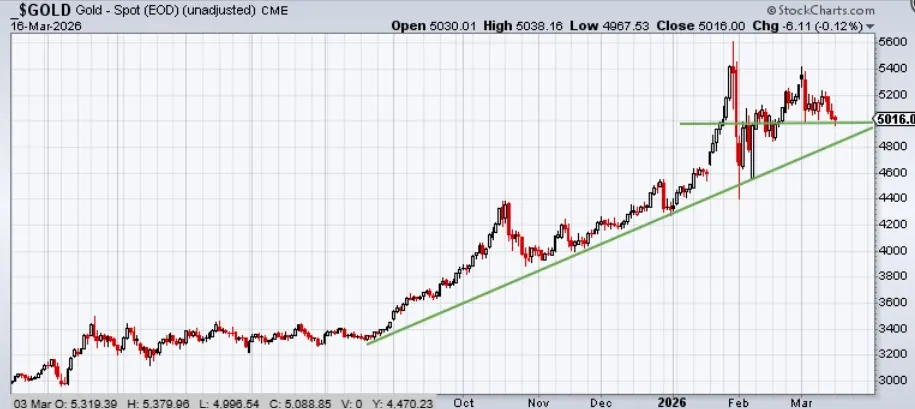
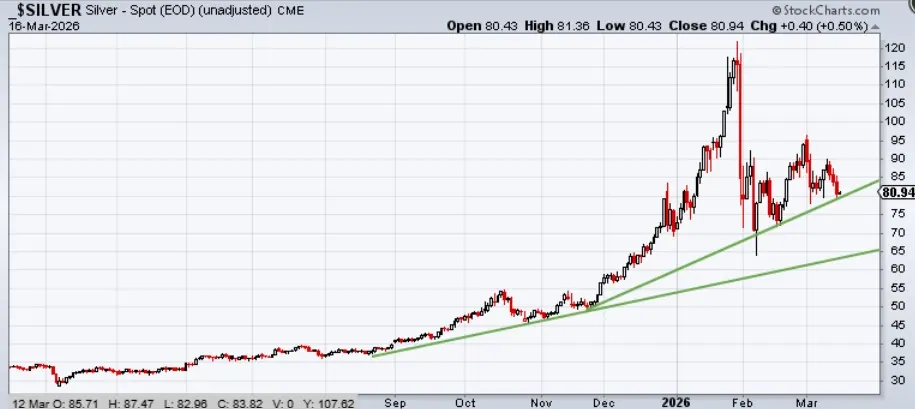
Parabolic rises in markets elicit a lot of emotion. Those holding on the way up are ecstatic. When the break occurs, however, many questions arise, chief among them is, “Is the bull market over?” “How low will the correction drop?” We would suggest that the answer to the first question is “no.” The rapid rise in the price of precious metals was not driven by speculation. It was driven by increasing geopolitical turmoil and the associated financial and economic challenges that accompany such turmoil. And we all know that is not going to end soon.
The second question is much more difficult to answer. The charts can offer some guidance. However, know that excursions can and do occur outside of the trendlines. With gold, we see a battle right now where we expected to see it during the rise. Instead of pausing at $5,000 per ounce, gold blew through it like it was no big deal. Now we’re seeing it act as strong support. We may see a drop into the $4,600 range as it seeks the trendline. However, that is no guarantee. The good news is, from our perspective, it appears that the downside in gold is limited before the bull market resumes.
With silver, we got what it always delivers. A major catch-up with gold. An overshoot. And a wild ride back down to sanity. Due to the sustained high demand from large buyers of silver, many were looking at the $130 to $150 area for a pause. Obviously, they were wrong. Silver’s fundamentals still remain strong. It’s just that, unlike any other commodity, silver likes to “scare you out or wear you out.” The charts indicate there may be good support at the present price level of around $80 per ounce. If both metals break this support in the coming week or so, the longer-term uptrend lines could be a great entry point for those who missed the breakout and massive move. Those would be $4,600 for gold and $65 to 70 for silver.
We don’t want to keep banging the drum, but for the vast majority of precious metals investors, dollar cost averaging and buying the dips are a good strategy during times like these. It’s why we built the OWNx platform as we did – to serve you in times like this.